
Blog
Understanding Corda Architecture:
Components, Network Design, and Transaction Flow
Understanding Corda Architecture:
Components, Network Design, and Transaction Flow



Blog
Understanding Corda Architecture:
Components, Network Design, and Transaction Flow
Understanding Corda Architecture:
Components, Network Design, and Transaction Flow





What is Corda Architecture?
Getting independent organizations to agree on the same version of the truth without giving up control of their own data has long been one of enterprise technology’s biggest challenges. Corda architecture is an open-source distributed ledger platform developed by R3 to address this exact problem in enterprise environments.
Unlike traditional blockchain platforms such as Ethereum or Hyperledger Fabric, the Corda platform architecture does not rely on a global network where every participant can see every transaction. Instead, it operates in a permissioned network where only the parties involved in a specific transaction have access to its data. Every participant is also a verified legal entity, which makes the platform suitable for regulated industries.
To understand what is Corda blockchain framework, it is important to examine the architecture behind it.
Technically, the R3 Corda architecture is structured into four main layers: a data layer of immutable states, a contract layer that defines business rules, a flow layer that automates workflows between parties, and a consensus layer managed by a Notary service that prevents double-spending.
Because of its privacy-focused and permissioned design, Corda is widely used in financial institutions and other regulated industries that require secure enterprise data sharing.
What Makes Corda Different from Traditional Blockchain Architecture
Traditional blockchain platforms were designed for open, trustless networks where participants are anonymous, every node processes every transaction, and consensus is achieved by broadcasting data to the entire network.
Corda distributed ledger architecture addresses the requirements of mutually distrusting legal entities that still need to reach an agreement on shared facts.
Have a look at this table to understand Corda vs Blockchain differences:
| Features | Traditional Blockchain | Corda |
|---|---|---|
| Data Sharing | Global Broadcast to all nodes | Peer-to-peer, only between parties to the transaction |
| Node identity | Anonymous or pseudonymous | Every node is a verified legal entity |
| Consensus | Network-wide mining or validation | Notary service confirms uniqueness; parties confirm validity |
| Ledger Visibility | Public or shared across all participants | Private states shared only with entitled parties |
Corda differentiates itself across these three dimensions:
Privacy: Corda's enterprise blockchain architecture ensures that transaction data is shared exclusively with the parties directly involved in an agreement, and any others with a legitimate need to know, such as a regulatory observer.
Scalability: When every node must process and validate every transaction, network throughput is constrained by the slowest and most burdened participant. Because Corda transactions flow only between counterparties, the network does not slow down as more institutions join.
Enterprise compliance: Every participant on a Corda network must hold a verified identity. Smart contracts carry explicit links to human-readable legal prose, ensuring that automated execution is grounded in enforceable legal agreements. The platform supports regulatory observer nodes, allowing supervisory bodies to maintain oversight without disrupting the transaction workflow.
Core Components of Corda Architecture
Corda platform architecture is a carefully composed set of components, each with a distinct responsibility. Together, these Corda components form a complete framework for enterprise transaction workflows.
The most significant Corda architecture components include:
Nodes
Every participant in a Corda network operates a node. Corda nodes are where everything happens. They host the business applications, manage the institution's data, and handle all communication with counterparties.
Each node hosts one or more CorDapps, the distributed applications that encode the business logic for a particular workflow. It determines what kinds of transactions the institution can participate in.
Every node also maintains a vault, its private, local database of all states it is party to. The vault holds both current (unconsumed) states and historical (consumed) states, giving each institution a complete and auditable record of its own position.
Corda node architectures communicate with each other exclusively through flows, which are structured, automated protocols that handle the step-by-step exchange of messages required to complete a transaction.
Notary Service
The Notary is Corda's consensus mechanism. Its sole function is to guarantee transaction uniqueness: confirming that the input states being consumed by a transaction have not already been consumed by a previous one. This is how Corda prevents double-spending without requiring global visibility into transaction contents.
When a transaction is ready to finalize, it is submitted to the Corda Notary with a request to check its input states. If none of those states have been previously spent, the Notary signs the transaction and records it as consumed. If any have already been spent, the transaction is rejected.
For enterprise networks requiring high availability and fault tolerance, Corda supports notary clusters: groups of mutually untrusting nodes that coordinate using byzantine fault-tolerant consensus algorithms. This means no single notary node represents a point of failure.
States
A state is the foundational data object in Corda. It represents a digital record of a shared fact between two or more parties.
Corda states are immutable. Once created, it’s never edited. When the underlying fact changes, the existing state is consumed and a new state is created in its place. The consumed state is archived permanently. This immutability guarantees a complete, tamper-proof audit trail of every version of every fact recorded on the ledger.
The lifecycle of a state in a Corda ledger model moves through three stages. It is first issued, created by a transaction with no inputs. It is then transferred or evolved through subsequent transactions that consume the current state and produce an updated one. Finally, it is consumed by a transaction that produces no successor, representing the termination of the agreement.
Contracts
A contract governs what state transitions are permissible. Every state on the Corda ledger references a contract, and every transaction that involves that state must satisfy that contract's rules before Corda contract validation.
These Corda smart contracts are written in Kotlin or Java, standard JVM languages familiar to enterprise development teams. They execute inside a sandboxed environment that enforces deterministic execution, meaning the same transaction will always produce the same result regardless.
Flows
Flows are the orchestration layer of Corda, the mechanism by which nodes coordinate with each other to build, negotiate, and finalize transactions. Corda flows are scripts that handle every step of a multi-party Corda workflow automation.
In an asset transfer, the initiating flow constructs the transaction, collects the recipient's signature, submits to the Notary, and finalizes the record in both vaults, entirely automated, with no central controller involved at any point.
Corda Network Architecture
A Corda network architecture is a peer-to-peer network of nodes representing verified legal entities that transact directly with one another without a central intermediary.
Peer-to-Peer Messaging
Corda nodes communicate directly with counterparties over AMQP/TLS, an encrypted, enterprise-grade protocol. Transactions are delivered only to the institutions involved. No other node receives, processes, or is aware of a deal it is not party to.
Network Map Service
The Network Map Service functions as the network directory that publishes the addresses, identity certificates, and available services of every node. When initiating a transaction, a node queries this map to locate its counterparty and establish a direct connection. Every node caches the map locally, ensuring availability during brief service interruptions.
Identity Management
Every node holds a verified identity, an X.509 certificate issued by a trusted certificate authority and cryptographically bound to every transaction it participates in. Each node corresponds to a known legal entity, making Corda's identity infrastructure a hard architectural requirement.
Permissioned Network and Governance
Joining a Corda network requires approval from the network operator. Upon admission, a node receives its identity certificate and is registered on the network map. The operator also defines the governance framework that covers which CorDapps are approved, what identity standards apply, which notary services are available, and how rule changes are managed, giving enterprise networks the institutional structure that regulated industries require.
Corda Transaction Flow Explained
Understanding how Corda transactions work is necessary to build on the platform. Here’s a step-by-step guide on the lifecycle of Corda transaction flow:
1. Transaction Proposal Creation
The initiating node constructs a proposed transaction, specifying the input states to be consumed, the output states to be created, and the command describing the intent. This proposal is assembled within the initiating flow before any counterparty sees it.
2. Counterparty Verification
The proposal is sent directly to the counterparty via peer-to-peer messaging. The counterparty inspects it, verifies it reflects the agreed terms, and if satisfied, signs and returns it. If rejected, the flow terminates, and nothing is recorded.
3. Contract Validation
With signatures collected, the contract's verify () function runs against the fully assembled transaction to check that every business rule governing the state transition is satisfied. If any rule is violated, the transaction is rejected regardless of how many signatures it carries.
4. Notary Uniqueness Check
The validated transaction is submitted to the Notary, which confirms none of the input states have been previously consumed. If clean, the Notary signs it and marks those states as spent, preventing double-spending at the point where the Corda transaction flow reaches finality.
5. Transaction Finalization
With the Notary's signature obtained, the transaction is irrevocable. The initiating flow distributes the fully signed transaction to all involved parties. No further approval is required.
6. Ledger State Update
Each party's vault updates simultaneously. Every participant holds an identical, consistent view of the new shared fact, with each state carrying a cryptographic reference to the transaction that produced it.
R3 Corda Architecture Diagram Explained
The R3 Corda architecture diagram illustrates how nodes, contracts, states, and the notary service interact to validate and record transactions across the distributed ledger.
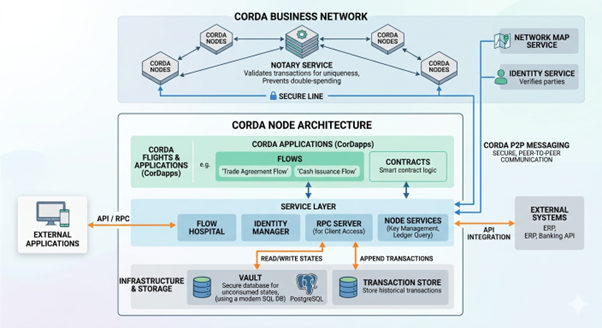
In this Corda architecture diagram:
- Nodes represent each participating institution on the network, host CorDapps, and maintain a Vault, their private database of all states it holds.
- CorDapps are the business applications that define the workflows that an institution can run.
- Flows orchestrate the transaction process between nodes, constructing proposals, routing them to counterparties, and collecting the signatures required to proceed.
- Contracts enforce the business rules governing every state transition.
- States are the immutable shared facts at the center of the architecture.
- The Notary Service provides finality, confirming that input states have not been previously spent before issuing its signature and making the transaction irrevocable.
- The Network Map Service underpins the entire network, maintaining the directory of node identities and addresses.
Enterprise Benefits of Corda Architecture
Corda was designed to give mutually distrusting institutions a shared, tamper-proof record of their obligations, without requiring them to surrender data control. That foundational design produces a set of benefits:
- Privacy-first architecture: Every transaction on Corda’s enterprise blockchain architecture is shared exclusively between the parties involved. For institutions handling sensitive financial agreements, it is a baseline requirement.
- Scalability: Because there is no global transaction broadcast, the network does not slow down as participation grows. Each transaction is an independent bilateral or multilateral event processed only by the relevant parties.
- Regulatory compliance: Every node holds a verified legal identity. Participation requires approval from the network operator. This permissioned structure means institutions always know who they are transacting with, satisfying the KYC and AML obligations.
- Enterprise system integration: Corda is built on the JVM, using Java and Kotlin, languages and toolchains that enterprise development teams already use. It integrates with existing databases, messaging systems, and back-office infrastructure without requiring institutions to replace or rebuild what they already have.
- Real-world asset digitization: The state-based ledger model supports a wide range of Corda enterprise use cases representing real-world assets and obligations in digital form. In banking, it supports the digitization of loans, bonds, and cash instruments. In insurance, it enables shared claims processing between insurers and reinsurers. In trade finance, it synchronizes documents and payment obligations across multiple counterparties. In supply chain, it tracks asset provenance and transfer of ownership across complex multi-party networks, all within a single, legally grounded architectural framework.
Industries Using Corda Architecture
- Financial services: Syndicated loans, bond issuances, and securities settlement across multiple counterparties, replacing bilateral reconciliation with a single shared record.
- Trade finance: Letters of credit, shipping documents, and payment obligations synchronized across exporters, importers, and banks, reducing delays and eliminating paper-intensive processes.
- Insurance: Claims processing shared between insurers and reinsurers, with each party seeing only the data they are entitled to and a full auditable record maintained throughout.
- Healthcare: Patient data and administrative records exchanged across institutions, with identity-based access controls ensuring information reaches only those with a legitimate need.
- Supply chain: Asset provenance and ownership transfers tracked across manufacturers, logistics providers, and retailers, providing transparency without sacrificing commercial confidentiality.
FAQs About Corda Architecture
What is Corda architecture?
Corda architecture is a distributed ledger framework for regulated financial institutions and enterprises. It allows mutually distrusting organizations to share a single, consistent record of their agreements without a central intermediary.
How is Corda different from blockchain?
Unlike traditional blockchains, Corda does not broadcast transactions to the entire network. Only the parties involved in a deal see it, and every participant is a verified legal entity.
What are the main components of Corda architecture?
Nodes, CorDapps, flows, contracts, states, the notary service, and the network map service.
What is a notary in Corda?
It’s a specialized service that prevents double-spending by confirming that input states haven't been previously consumed.
How does a Corda transaction work?
A transaction is proposed, validated by contract logic, signed by all parties, and finalized by the notary before both vaults update.
Is Corda a blockchain or distributed ledger?
Corda is a distributed ledger. It does not use blocks or chain transactions together at the network level, making it distinct from conventional blockchain platforms.





 View Previous Blog