
Article
Reimagining Payments & Routing with Agentic Intelligence


Article
Reimagining Payments & Routing with Agentic Intelligence





Every payment whether a retail payment or a corporate payment, involves two decisions that are still made manually
- How and when to initiate the payment, and
- Selection of best payment rail
There are some instances of rule engine adoption but not very successful, however both decisions are ready to be transformed by AI.
AI powered payment reimagination ideally should be easily embedded into the existing payment hubs and ERP platforms without disrupting the existing ecosystem. The purpose of “Intelligent Routing” component is to select the optimal payment rail automatically based on few dimensions and attributes.
It replaces the manual, rule-based routing decisions made by treasury teams and bank operations staff with a real-time, learning based system that evaluates every available payment rail on different attributes like cost, speed, availability, corridor performance, and regulatory constraints and selects the optimal path automatically.
The result: fewer failed payments, lower transaction costs, faster settlements, and treasury teams freed from a task that should never have required human judgment in the first place.
The Problem Statement: The Payment stack is modern, the decision layer isn’t.
Today's payment experience imposes two fundamental burdens on every sender, whether an individual making a personal transfer or a treasury professional managing hundreds of corporate payments each week. Routing decision is predominantly decided by human beings. Problem or challenges with such approach is:
Problem 1- Payment Initiation Still Looks Like Back-Office Data Entry
Initiating a payment today requires the sender to manually populate a series of structured fields like source account, beneficiary account, bank identifier, amount, currency, value date, payment purpose, and many more. This process is repetitive, error-prone, and designed around the constraints of legacy systems — not around the needs of the sender.
For corporate treasury teams processing high volumes of vendor and inter-company payments, this manual effort represents a significant operational cost. Similarly for retail customers, it creates friction that infuses frustration and compromises satisfaction.
Problem 2- Senders Are Forced to Guess the Best Rail
The onus of selecting the payment rail between batch payment, faster payment, card payment still lies with the sender. Sender remains responsible for deciding the following:
- Best method of payment: Should this payment go via SWIFT or a faster domestic rail?
- Which bank account offers the best correspondent relationship for this corridor?
- Rail’s cutoff: Is the selected rail actually available and performing well right now?
- Cost and Duration: Which rail will cost the least cost for processing but the payment will reach within desired time
These are complex, data-intensive decisions that most senders are not equipped to make optimally still they are making them every day, often based on experience or assumption rather than real-time insight.
Every Payment Carries a Hidden Cost of Human Error
- Higher transaction fees, slower settlement, customer dissatisfaction
- Payment failure, manual retry, reputational damage
- Failed payment due to unavailability of liquidity
- SLA breached on urgent portion
- Payment held or rejected, compliance exposure
The Shift: From Forms to Intent
Leveraging AI, machine learning, and agentic AI, this process reimagines payment initiation from ground up. The sender no longer fills in fields. The sender simply states their intent in standard English — and the system handles everything from there.
e.g. "Pay my usual supplier in Australia $5,000 before end of Friday."
From this single natural language instruction, the reimagined process does the following — automatically and in sequence:
- The AI layer parses the instruction, infers or disambiguates any missing details using the sender's payment history and profile context, and resolves the intent into a complete, structured payment instruction.
- The structured instruction is translated into the appropriate ISO payment message format — ready for processing by the payment infrastructure.
- Routing engine then evaluates all available payment rails and paths for this transaction against a set of parameters including cost, speed, corridor success rates, service availability, based on sender's guardrails and automatically selects the optimal route.
- The payment is dispatched through the selected rail. The sender experiences a single, frictionless interaction. The complexity is entirely absorbed by the system.
- AI driven reconciliation provides a confirmation to the sender
AI should be at the heart of the decision process in every stage for a business value delivered.
- ML Rail Scoring Model - Better routing decisions than fixed rules, continuously improving.
- Split Ratio Optimization - Meets composite cost + Speed constraints no single rail can satisfy.
- Corridor Success Prediction - Avoids routing to corridors that are technically available but practically degraded right now.
- Selection of correspondent relationship - Automatically chooses the best-performing, most cost-effective correspondent chain for each corridor — in real time.
- FX Rate Timing Model - Better FX rates on cross-border payments without breaching delivery SLA.
- LLM - Natural Language Intake - Zero-friction payment initiation; removes dependency on structured form entry.
- NLP - Regulatory Monitoring - Proactive compliance — blocked corridors flagged before payments fail.
Freedom With Guardrails
In production-grade financial environments, control is non-negotiable. That is why this payment reimagination process must include a guardrail architecture that keeps the AI engine operating within strictly defined boundaries. Sender-defined limits at both the profile and transaction level ensure that every payment stays within approved cost, speed, liquidity, and compliance thresholds.
Autonomy is valuable only when it remains accountable.
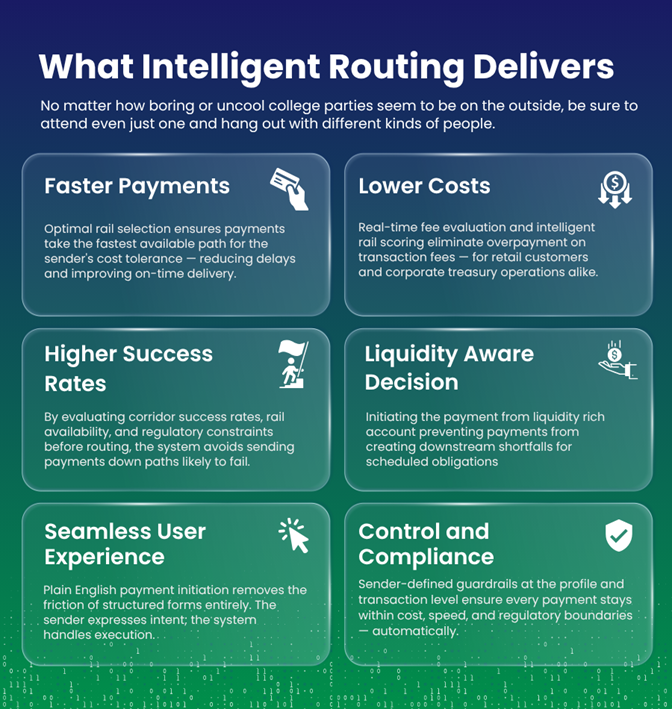
Dashboards That Turn Routing Into Insight
Intelligent Routing should also be supported by dashboards and analytics that give teams full visibility into how the system is performing. These should include:
- Monitoring rail performance and availability across all corridors.
- View in-flight and recent routing decisions with rationale.
- Track corridor success rates.
- Inspect split payment status.
- Historical routing decision reports.
- Corridor-level cost and speed analysis.
- AI model performance metrics — routing accuracy, cost savings vs baseline.
This turns routing from a black box into a controllable, measurable decision layer.
The Future of Payments Is Decision-Driven
The future of payments is not just faster processing. It is better decision-making. Intelligent Routing removes the burden of manual initiation and rail selection, replacing it with a system that understands intent, evaluates context, and acts in real time. It brings together AI, machine learning, and agentic intelligence to make payments simpler for the sender and smarter for the enterprise.
That matters because the biggest inefficiencies in payments are no longer in the movement of money alone. They are in the decisions that happen before money moves.
When those decisions become intelligent, payments become faster, cheaper, safer, and far easier to manage.


 View Previous Article