
Article
Modernizing BI Reports:
From Legacy to Leading-Edge
From Legacy to Leading-Edge


Article
Modernizing BI Reports:
From Legacy to Leading-Edge
From Legacy to Leading-Edge





Ever waited 10 minutes for a simple report to load—only to realize it’s already outdated? That’s the daily reality for countless teams stuck with legacy BI tools. Data Analysts at large enterprises dread month-end reporting: clunky interfaces, slow queries, and sky-high licensing fees that limit access to just a handful of users. Sound familiar? You're not alone—and there’s a better way forward.
From Static Reports to Self-Service Intelligence
The era of static downloads and manual report generation by engineers has already given way to a more empowered approach, where users can generate reports, extract insights, and make informed decisions on their own. The integration of OLTP and OLAP systems, supported by ETL processes, has facilitated this transition by enabling structured reporting and analysis. Traditional BI platforms such as Crystal Reports, SSRS, Business Objects, and Cognos provided valuable capabilities in this space, but they also came with limitations, particularly around interactivity, real-time insights, and self-service capabilities.
Business Critical Challenges
- Manual & Time-Consuming: Report developer dependencies entail longer build cycle for change management
- Data Silos & Inaccuracy: Legacy systems are often disconnected, creating fragmented data. This leads to conflicting reports and a lack of a single source of truth.
- Static & Outdated Insights: Traditional reporting is a post-mortem analysis. It tells you what happened in the past but doesn't provide real-time insights for proactive decision-making.
- Poor User Experience: These systems are often clunky and not user-friendly. Finding information is difficult, and the visuals are basic, not interactive.
- Cost – Maintain, upgrade, patch: Cost associated with it. Also, with every licensed enterprise grade tool – a steep cost is evident.
Tool Centric Limitations
- Business Objects - Heavy reliance on IT engineers to build semantic layer
- Cognos – Learning curve, less self service, lack of customization
- MS SSRS – Paginated reports, less interactive
- Crystal Reports – Static reports, developer effort required for changes
Why Modernize BI Now
Traditional Reporting platforms were built on on-prem data warehouse, which served as source of data for OLAP. There were challenges observed with respect to rigid data schemas and ETL pipelines. Lot of new modern cloud data warehouses and lakehouse platforms like Snowflake, BigQuery, Clickhouse have –
- Near real time data ingestion
- Capability to perform analytics at scale
- Support for semi-structured data
These backend platforms provide scalability, faster and governed data storage to modern BI solutions like Google Looker, Tableau, Power BI. With this solid foundation of data at back end, these modern Reporting platforms provide multiple key offerings like –
- Interactive & Real time dashboard - Real time data & insights, Drag drop feature
- AI/ML powered Analytics – Analytics for non-technical team via natural language Q&As ( Power BI Q&A, Tableau Ask Data, Looker Q&A)
- Powerful visualization – Rich library of charts, graphs enabling data story telling
- Advanced Data connectivity – Connect to various data sources ( Data lake, Data base ( Aurora, Azure SQL server, ) Cloud data warehouses( Snowflake, Redshift) , Data stream Kafka, Pub-sub )
- Collaboration – Integrate with Slack, Teams, and sharing reports for cross team alignment.
Teams can also use an AI video generator to convert dashboards and insights into short explainer videos, making complex data easier to share, understand, and align on across stakeholders.
With these offerings, modern BI reporting solutions can help user play advanced role of data strategist, provide better user experience and influence recurring spends by giving long term ROI. Question is how to plan the migration?
Suggested Approach to Modernization
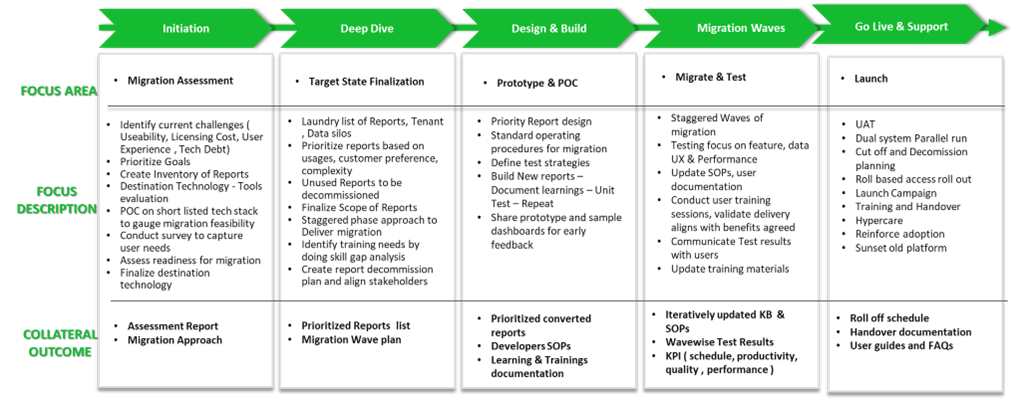
Challenges in Modernization
Some of the key challenges to anticipate while migrating legacy reports to new technology
- User Adoption
• The decision to upgrade the reporting tool may encounter challenges due to user reluctance or resistance to adopting the new system - Technical Skills
• Skilled resources in source or target reporting tech stack can hard to find
• Sometimes the target skills can be cost efficient, but not most popular technologies for the engineers - Legacy code Complexities
• Typical migration is done for modules, products projects which are existing and long running .
• This requires a deep dive, knowledge of the existing system, their interdependencies, business rules.
• Require prompt and correct direction from SME - Effort estimation
• The standard estimation techniques may not be enough
• Require customized approach by considering above points and anticipate unknowns
• Prompt and efficient query resolution will be essential to ensure the schedule, effort is well within adherence limits - Source vs Target Reporting tools compatibilities
• Typical source vs target reporting technology choices are based on various factors like cost, features etc. and are done prior to project kick off.
• During execution some unknown limitations of targets can be unearthed. This requires out of box thinking to make new system as close to old one.
• Any requirements, which requires new feature development, or additional effort needs to be assessed properly as can quickly take toll on timelines - Testing & Quality Control
• Migration project requires mainly manual verifications
• Requires thorough understanding of the system, functional test cases documented thoroughly
• Automation may not have immediate scope in migration project
• Depending on volume of reports being migrated, the manual effort can also become huge
• Complexities are added by various factors like ,checking each report, fields, UX , formatting, performance, look and feel, data etc. - Data for Report Testing:
• Typical customer facing production reports need specific configurations, data
• Availability of Test, UAT environments with data close to production setup can be a challenge
The SME knowledge is crucial in this case as well as inter system dependencies and how it impacts data comes into play
Enablers of Successful BI Modernization
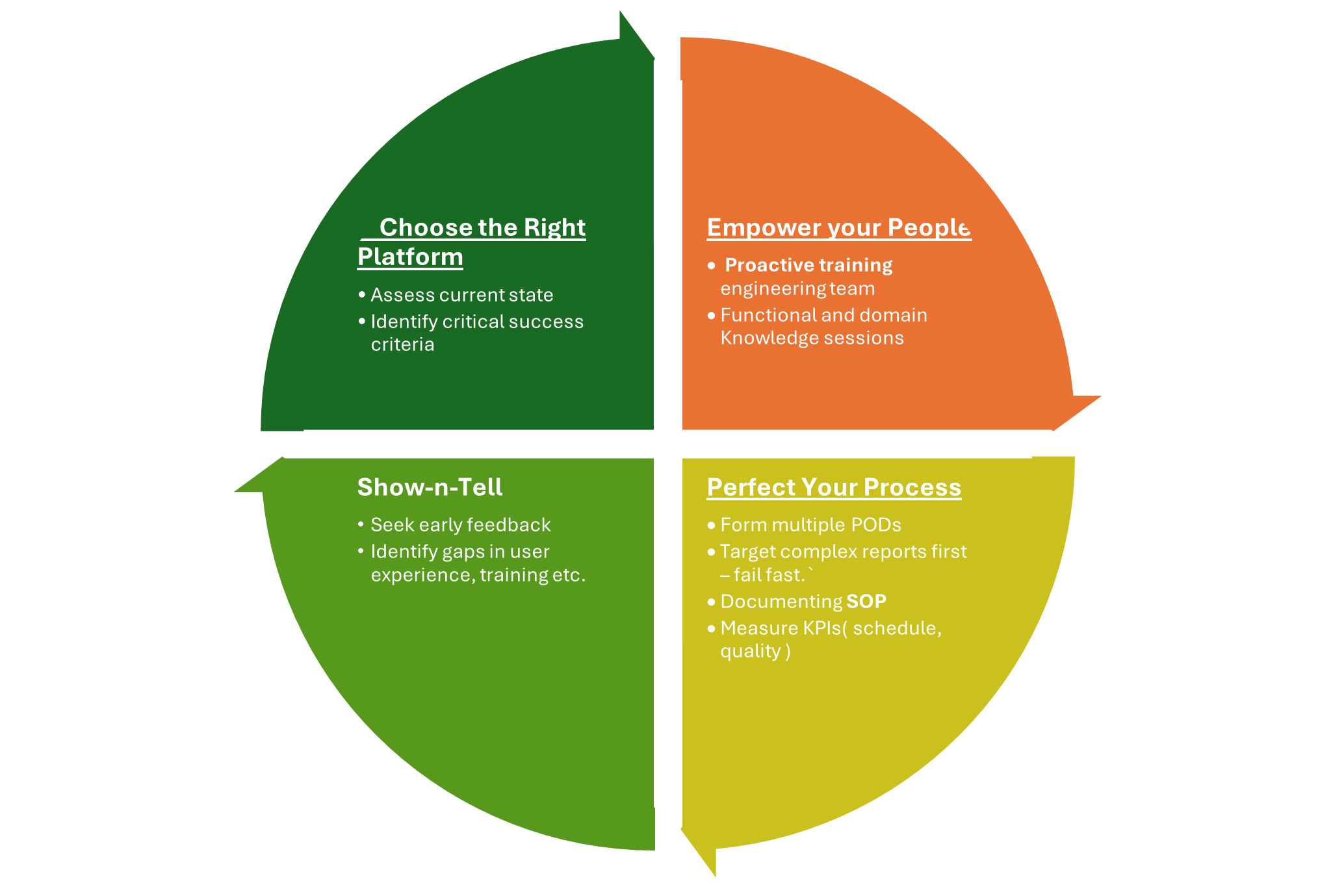
In a Nutshell
Overall, BI Report modernization initiative can be transformational in multiple ways for business, operations and technology teams alike. It can help deliver faster, better decision making which is backed with strong data driven decision and enhance user experience too. However, like with any transformation program, this requires well planned approach with clearly defined goals, strong governance and methodical execution to minimize uncertainty and disruption.


 View Previous Article