
Article
AI@Scale in Banking: Make Pilots Successful – Faster to Production


Article
AI@Scale in Banking: Make Pilots Successful – Faster to Production





Building compliance-ready, risk-managed, and framework-driven GenAI for secure, scalable, enterprise-wide adoption
Generative AI is reshaping the BFSI sector, with leaders running pilots across customer service, risk, and operations. An EY study estimates that GenAI could lift productivity in Indian financial services by 34–38% by 2030, and 74% of firms already have pilots running, yet only 11% have reached production. This gap is not about ambition; it is about crossing the checkpoints between pilots and real outcomes in production. Most pilots wind up due to weak integration, security blind spots, and systems that were never built to scale. This article examines why GenAI struggles to move beyond pilots, highlights the need to embed essentials of AI across SDLC phases and roles, and outlines how organizations can translate demos into measurable business value.
Why Banks Struggle to Scale GenAI
Banks struggle to scale GenAI because the rules are different in BFSI. Accuracy is absolutely non negotiable. This is where Banking AI compliance requirements collide with GenAI’s subjective outputs. In a highly regulated industry like banking, even one inaccurate, ambiguous, or uncertain prediction can trigger penalties or losses and that risk keeps many pilots frozen.
There is also a structural disconnect: innovation teams move fast, production teams move carefully, and compliance teams are engaged later in the process. The result is complex, governance-heavy GenAI regulatory challenges that banking leaders did not anticipate. Operational gaps make it worse: most pilots run without strong AI governance or clear acceptance criteria. Legacy systems add friction, and data remains trapped in silos.
These failure patterns show up repeatedly, for example:
- Pilots ignore real banking environments; security and privacy are overlooked.
- Business outcomes are vague, so no one can sign off for production.
- Business, Technology, and Compliance are not on the same page; the business case and ROI are not well articulated.
- AI is treated as a one off project, often limited to proof of concepts without full commitment.
- Solutions are not designed as enterprise platforms and lack data, application, and security due diligence.
The Real Challenge is to Meet Cross-Functional Requirements
GenAI in banking must satisfy many stakeholders at once. Each group views risk differently, and scale suffers when even one concern is ignored.
- Compliance Teams
They look for control and accountability. They need transparency on how an output was produced, whether bias was controlled, and whether decisions can be audited. Regulatory reporting and data residency rules add pressure, especially when sensitive customer data crosses systems or locations. They also require clear policies on data usage, model behaviour, ethical practices, and third party AI services, along with the ability to demonstrate compliance to regulators at any time. Without this level of documentation, even a powerful GenAI solution will struggle to gain production approval. - ML Model Risk and Governance Team
These teams focus on model risk hallucinations, inconsistent answers, and uncontrolled responses. They expect strict model versioning and lineage so every decision can be traced back to a specific model and dataset. They also look for controls around model drift, prompt changes, and retraining cycles to ensure risk does not silently grow over time. Without continuous monitoring and clear approval gates, even a well performing GenAI model can become a compliance and reputational risk. - Technology Teams
They own execution. Legacy systems complicate integration, while data security for GenAI in banking requires strong PII protection. Technology teams must design pipelines that scale, decide between cloud and on prem deployments, and build guardrails, monitoring, and model update processes. The bar is high: near 100% accuracy and high availability are expected before production go live is even considered. Any weakness in this foundation can turn a promising pilot into an operational risk. - Business Leaders
This group cares about outcomes. They want clear ROI, faster cycle times, better customer interactions, and fewer manual reviews. They also expect predictable delivery, controlled risk, and the ability to scale successful use cases across business units. If GenAI cannot move beyond pilots into repeatable, revenue impacting operations, leadership confidence erodes quickly. Without alignment across priorities, enterprise wide adoption remains out of reach. - System Users (Operations, Analysts, Frontline Teams)
These are the people who work with GenAI every day. During early adoption, they often run GenAI in parallel with existing processes, validate AI generated outcomes, flag errors, and provide continuous feedback for training and tuning. Paradoxically, their workload can increase before it decreases. Without clear change management, incentives, and trust in the system, resistance to adoption is natural and this human factor is often the biggest hidden risk in moving GenAI from pilot to production.
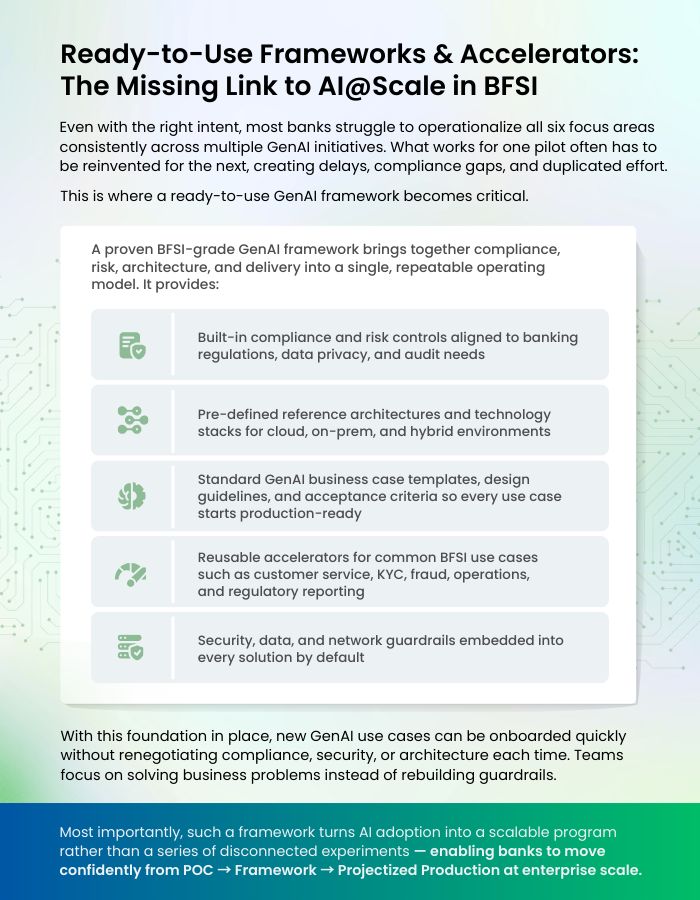
A Proactive Path to AI@Scale in Banking
Successfully scaling GenAI in banking is not about launching more pilots; it is about actively aligning stakeholders, streamlining processes, and embedding governance and compliance from day one. In a complex, regulation-heavy environment, GenAI must be treated as an enterprise program, not a digital experiment.
It is essential to establish standardized architectures, approved technology stacks, validated models, clear acceptance criteria, and robust evaluation mechanisms upfront. This discipline turns the journey from POC to production from a long, uncertain path into a controlled, predictable, and repeatable process, enabling GenAI to scale confidently across the enterprise.
1. Compliance Ready Design and Risk Controls
Compliance, risk, and audit cannot be retrofitted after a pilot succeeds, they must be part of the solution from day one. Teams need to know which models they are allowed to use, what data is safe, how prompts are managed, how ethical practices are enforced, and how results can be reviewed and explained.
Setting up clear, organization wide GenAI guidelines on approved models, data usage, prompt handling, and audit expectations ensures that every team builds pilots that are already fit for production.
2. Approved Architecture and Technology Stack
GenAI needs enterprise grade foundations, not isolated setups. That means clear reference architectures, integration patterns, security controls, and agreed deployment models cloud or on prem. Without this, pilots may look good in demos but become difficult to scale or secure.
Many POCs built on public cloud tools with unrestricted data access have worked in pilots but required complete redesign when security, data residency, and audit requirements were applied for production. Standardizing approved technology stacks and data pipelines lets teams move from pilots to production without rework or redesign.
3. Production Grade Engineering and Reliability
POCs prove concepts; production runs the business. Production grade GenAI requires secure and resilient pipelines with PII protection, monitoring, fallback mechanisms, high availability, and controlled model updates. Near 100% accuracy, stability, and operational readiness are non negotiable for banking go lives.
Because GenAI tools are easy to spin up, solutions are often built without core engineering discipline, leading later to outages, data leaks, or unreliable results. GenAI projects must be executed like any other mission critical platform, with proper testing, monitoring, and release controls before they are trusted with real users, high volumes, and time critical processes.
4. QA for AI: Guardrails and Acceptance Criteria
Not every GenAI model is ready for production. Like any software, AI needs rigorous testing before go live. Teams must know which models are approved, what accuracy thresholds apply, and how outputs will be validated.
Unlike traditional systems, GenAI produces subjective or probabilistic answers, so QA cannot rely only on fixed test cases. It must include human review, scenario based testing, and risk based evaluation. A model that sounds confident can still give subtly incorrect regulatory or customer guidance. Clear QA checks accuracy, explainability, and risk sign off ensure that only trusted AI is used in real business processes. Without this discipline, small errors can quickly become compliance, financial, or reputational issues.
5. Business Case–Driven Value
GenAI matters only when it delivers measurable business impact: faster processing, lower costs, reduced risk, or better customer experience. These outcomes must be defined upfront and tracked from POC through production so leaders can see what is working and decide what deserves to scale.
A standard GenAI business case template should capture expected benefits, risks, effort, and success metrics before any use case is approved. This keeps the focus on value, not just experimentation.
6. AI Governance and Continuous Oversight
GenAI systems are not static. Models are updated, prompts change, and accuracy can drift as data and usage patterns evolve. Without regular checks, a solution that worked well in a pilot can become unreliable or risky at scale. A minor prompt tweak aimed at better customer responses, for instance, might inadvertently generate incorrect regulatory guidance or expose sensitive information.
An AI Governance Board should own and maintain enterprise standards including the GenAI business case template, approved design guidelines, model and prompt standards, reference architecture, and technology stack and ensure safe, ethical AI/ML practices. This group should also educate and support delivery teams so they know how to build GenAI solutions the right way. Any change to prompts, models, or training data should go through this board for review and approval, ensuring GenAI remains safe, compliant, and production ready as it scales.
From Project to Living Capability
GenAI is not a one time project; it is a living, evolving capability that grows as data, models, and business needs change. What works for one business unit must be designed to scale across the enterprise, and what works today must be continually strengthened for tomorrow.
Because GenAI touches every function, the workforce must be AI enabled not just trained, but empowered to apply intelligence as part of their everyday roles, delivering higher productivity, better quality, and greater speed. Banks that move with both speed and discipline, and that build frameworks, guardrails, and operating models that adapt as GenAI expands, will turn GenAI into lasting competitive advantage.
In summary, AI@Scale succeeds when banks move beyond pilots with clear governance, measurable outcomes, and workforce readiness. Surely, the Banks that operationalize GenAI with control and purpose will be leading the next phase of digital banking with Applied Intelligence.


 View Previous Article