
Blog
Building Proactive Azure Monitoring with Datadog & BitsAI



Blog
Building Proactive Azure Monitoring with Datadog & BitsAI





If you’ve ever found yourself in a 2 a.m. war room, frantically shifting through a million logs to find the root cause of an outage a customer reported, you know the pain of reactive monitoring. Our organization was stuck in this exact cycle. Our engineers, the very people hired to build and innovate, were becoming professional firefighters. Alert fatigue was real, customer satisfaction was slipping, and the root cause of recurring issues remained a mystery. We had the data—terabytes of it in Azure and Datadog—but we lacked the intelligence to make sense of it all before it was too late.
Our wake-up call was realizing that more tools weren't the answer; a smarter, unified approach was. We stopped adding monitors and started building an AI-Ops ecosystem with Datadog's BitsAI at its core. This wasn't just an upgrade; it was a complete paradigm shift from reactive troubleshooting to proactive prevention.
The Paradigm Shift: From Reactive to Proactive with AI-Ops
We recognized that adding more monitors or dashboards wasn't the answer. The problem wasn't a lack of data; it was a lack of intelligent correlation. We needed a system that could connect the dots across our entire Azure ecosystem—from App Services and Azure SQL to Cosmos DB and Container Apps - and tell us what was wrong, not just that something was wrong.
Our solution was Project Aegis, an AI-Ops initiative built on Datadog with one core mission: to predict and prevent incidents before they impacted users. The cornerstone of this new approach would be Datadog BitsAI.
BitsAI: The Conversational Brain for Our Observability Data
While Datadog’s traditional monitors and dashboards were powerful, BitsAI was the game-changer. It acted as the central brain of our operations. Instead of manually jumping between the APM, Logs, and Infrastructure sections, our engineers could now simply ask questions in natural language:
- “BitsAI, what’s causing the high latency for the user-api service?”
- “Show me all errors related to the latest deployment.”
- “Is there a correlation between the payment-service errors and the database CPU?”
BitsAI would instantly analyze terabytes of correlated data—metrics, traces, and logs—and provide a concise, intelligent answer with links to drill down deeper. It transformed our engineers from digital detectives into empowered problem-solvers.
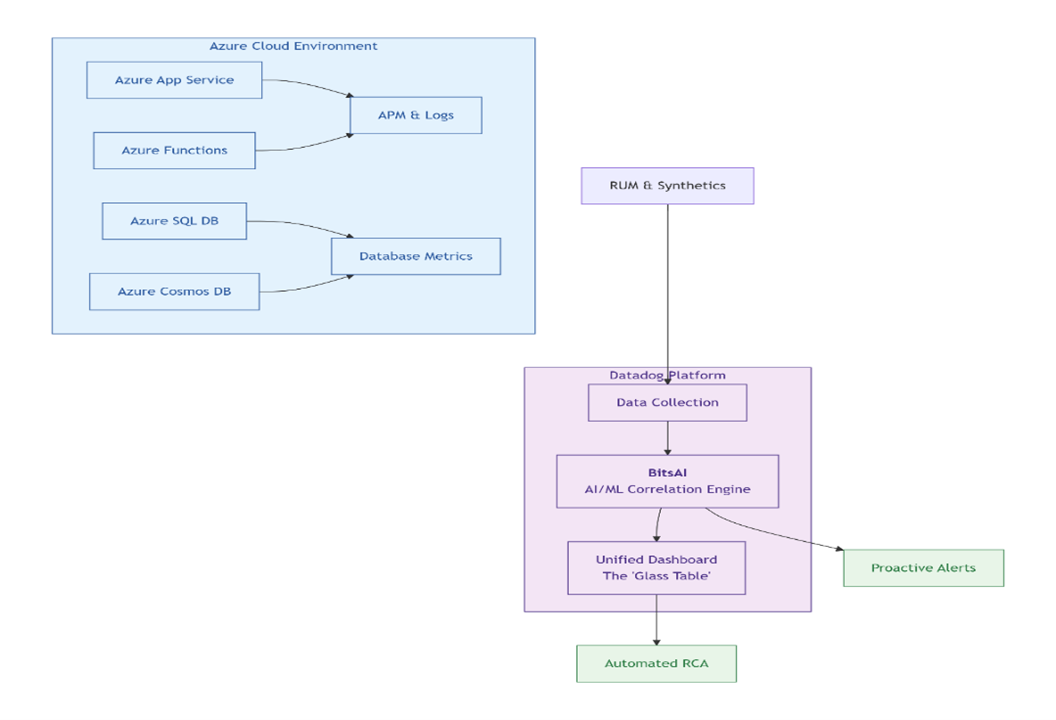
The architecture of our AI-Ops system looked like this:
Building Our Intelligent 'Glass Table' Dashboard
For BitsAI to be effective, it needed high-quality, well-structured data to analyze. We built what we called our 'Intelligent Glass Table'—a unified observability foundation in Datadog. This involved:
- Unifying Data Silos: We integrated Real User Monitoring (RUM), Application Performance Monitoring (APM), Database Monitoring (DBM), and Synthetic tests into a single pane of glass.
- Consistent Tagging: We enforced a strict tagging policy (env:production, service:user-api, team:backend) across all Azure resources and applications. This gave BitsAI the context it needed to accurately correlate events across our entire stack.
The Result: From Toil to Transformation
The impact was quantifiable and profound. Within three months of fully implementing this system:
- Mean Time to Resolution (MTTR) dropped by over 50%. BitsAI’s automated root cause analysis turned marathon debugging sessions into quick fixes.
- Customer-reported tickets for performance issues fell by 60%. Our synthetic checks and anomaly detectors now found problems before our users did.
- We reclaimed an estimated 5-10 hours per week, per team, previously lost to manual toil. Our engineers were no longer detectives; they were now doctors, proactively healing the system.
Your Blueprint for Proactive Operations
If you see your own organization in our "before" story, the path forward is clear. Stop adding more monitors and start building a connected, intelligent system.
- Unify Your Data: Break down silos with consistent tagging.
- Empower with AI: Leverage tools like Datadog BitsAI to act as your operational brain.
- Focus on Outcomes: Measure success not by the number of alerts, but by reduced downtime and increased innovation.
The future of operations isn't reactive; it's predictive. And with the right AI-powered approach, that future is within your reach.





 View Previous Blog